
How do think tanks think about their own teams?
What are some of the thoughts and patterns of teams within these orgs which enable them to flourish?
Most think tanks are very good at the thing they are known for: producing sharp, credible, well-timed work. They are rarely built to sustain the organisation that produces it. Grants follow outputs, reputations are built on outputs and the internal scaffolding (how decisions get made, how priorities move, how people understand their roles) tends to be held together informally, on trust.
Until the day it cannot be…
That gap is where we spent a few months with the Centre for Communication Governance (CCG) at National Law University Delhi, one of India’s leading academic research centres on technology, law and policy. The centre had grown organically for a decade and that growth itself was what surfaced the need. As CCG’s leadership put it:
“There was a recognition that the organisation had outpaced some of its internal structures. We wanted to be more deliberate about how we work together, not just what we produce.”
Holding two modes at once
CCG sits in an unusual place. Being part of a law university gives it grounding, credibility and a longer analytical horizon. Operating like a think tank keeps the work close to live policy questions and real timelines. As CCG’s leadership put it to us:
“The culture needs to hold both modes, being rigorous and responsive, methodical and timely. It’s our real strength when it’s working, and it takes active attention to keep the structure sustainable.”
Most organisational playbooks assume a single operating tempo and do not fit a centre that runs two at once. That is not something you solve with an off-the-shelf framework.
When informal works, until it does not
CCG grew organically for a decade. As the team and the work grew more complex, the informal ways of working that had served a smaller operation started to strain.
“A lot of how CCG has operated has been held in shared understanding rather than shared structure. That works in a high-trust environment, but it gets harder to maintain as the team and the work grow.”
High trust is not the same as structure. It is what lets an organisation manage with thin structure for a while. The strain rarely shows up as a crisis. It shows up as friction: mismatched expectations, priorities clear to the people who set them but not to everyone else, roles understood but never named.
What the work looked like
Think tanks deal with the abstract, and abstraction carries a sense of purity and perfection, but the lived realities of think tanks are messy and embodied. The deeper challenge was to acknowledge and embrace this paradox.
Rather than working through a long list of issues and reducing the paradox to a checklist, we used a diagnostic to notice the larger patterns the team was already circling and sensing. The focus areas were not picked off a shelf.
“The three areas weren’t chosen arbitrarily. They came out of a diagnostic process where patterns across the team pointed to the same underlying needs.”
There were three patterns we chose to engage. Each was then worked through asynchronously over three to four months, alongside everyday operations, by smaller teams within the organisation.
“The asynchronous, spread-out nature of the process let us keep working on our focus areas alongside everyday operations. It made the process participatory and team-led.”
We were not there to arrive with the answer, but to help the organisation hear what it already knew and had not yet said out loud.
What we took away
First, we saw the value of making implicit things explicit. A lot of friction comes from expectations no one ever stated; naming them, and writing some down, eased more than we expected.
The second was that culture is not separate from operations. How decisions get made, how priorities travel, how people understand their roles all get filed under culture, but they live in the daily running of the work. Treating them as operational questions, rather than soft ones to handle later, made them workable.
These were not abstract gains. They showed up in how the work was owned day to day.
“The work tracks that emerged from the process have given people clearer ownership and made the organisation’s upcoming priorities more legible across the team.”
“It’s early to draw firm conclusions, but the shared vocabulary and shared priorities that came out of the work are already making certain conversations easier.”
Why this work is needed and rarely done
Organisations at the research and policy interface tend to pour their attention into output and far less into the infrastructure that sustains it. That catches up eventually. An outside perspective helps here, not because facilitators know more, but because some patterns are hard to see from inside the daily flow.
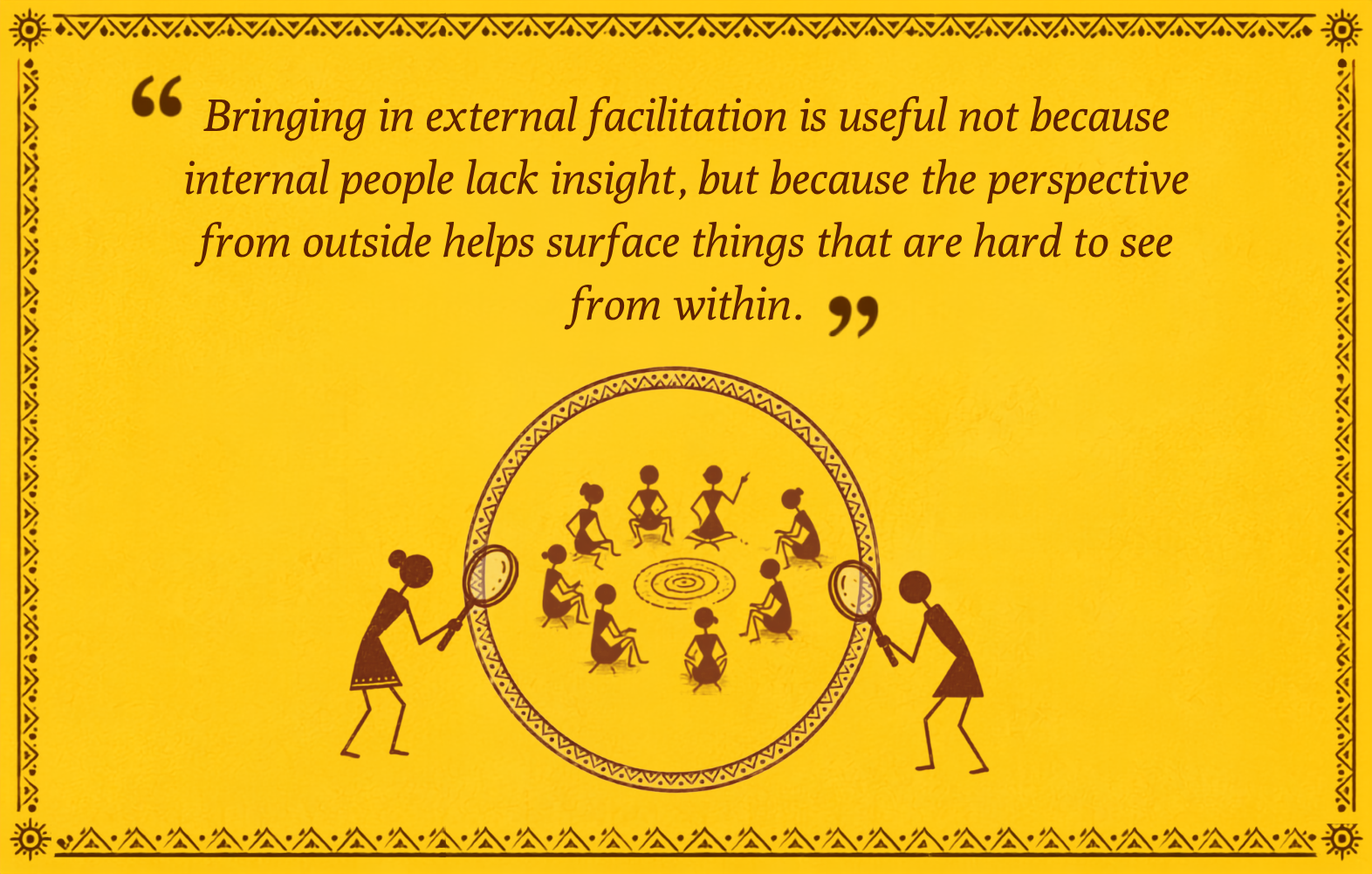
“Bringing in external facilitation is useful not because internal people lack insight, but because the perspective from outside helps surface things that are hard to see from within.”
In our experience, the changes that last share three things: an outside perspective; focus areas drawn from friction people already feel, not from what sounds right on paper; and work done collectively, since culture built together holds better than culture handed down.
“Working with teams collaboratively, paying attention to everyone’s voice, is the only way to ensure that organisational cultures remain evolving and sustainable.”
For a sector whose value rests on the quality of its thinking, the organisation that does the thinking deserves the same care
This article is jointly written by Wisdom Tree and Centre For Communication Governance at NLU Delhi.